The Place-Name Shortcut: Why One Word Cannot Explain a Landscape
Learn how to read a place-name alongside local speech, older records and terrain, so you can separate useful clues from claims the evidence cannot support.
A place-name can hint at the language or history of a landscape, but one word rarely explains how a place came to be. Read the name alongside neighbouring names, local speech and the physical setting, and you can see where a plausible clue ends and a stronger claim needs more evidence.
The trouble is not that names are useless clues. It is that readers ask them to identify a people, date a settlement, explain a boundary and describe the land all at once. Each claim needs a different kind of support. A careful reading keeps the pleasure of noticing a name without asking it to carry a whole history.
A familiar word does not settle a place-name’s meaning
A name may resemble a familiar word in English or another language, and the resemblance can feel decisive. Yet spellings change, sounds shift, and names may be borrowed or reshaped as they pass between speakers. A modern-looking syllable does not necessarily carry its current meaning in an older name.
Separate what you can observe from what you are inferring. Write down the name as it appears on the map, then note the tempting interpretation separately. Ask whether that reading still makes sense if you allow for older spellings, local pronunciation or a meaning that has changed.
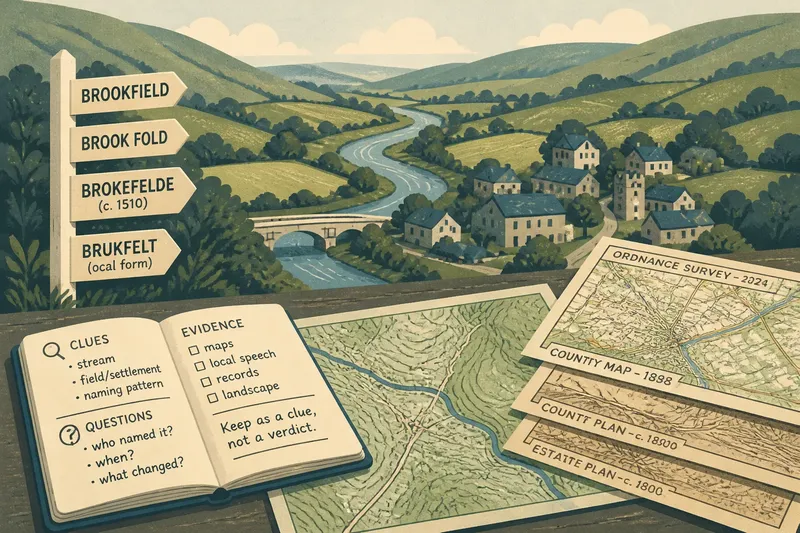
Say you see “Brookfield” beside a broad valley and assume the name records a brook that once defined the settlement. Imagine you check a local map and find that the nearby stream has another name, while “Brookfield” appears across adjoining streets and in the name of a former estate. That comparison does not establish an origin, but it does distinguish the name’s present associations from evidence still needing explanation.
Keep the first reading as a clue, not a verdict.
A name alone cannot prove who lived in a place
Place-names can preserve traces of languages and naming practices, but a name alone does not establish who occupied a place, when a language was spoken there or how a community changed. Names can survive population shifts; newcomers can adopt older names, and mapmakers or administrators can record a local form using spelling conventions from another language.
The common leap is from linguistic resemblance to a complete social history. A name that appears to have roots in one language may be worth comparing with other local names, but it cannot by itself identify a community or settle questions of continuity. Look for independent context, such as older maps, place-name records and local histories.
When sources disagree, keep the disagreement visible. “Possibly connected with…” is more honest than a confident origin story unsupported by the name itself. For a sensitive identity claim or contested local history, consult relevant local expertise rather than presenting a linguistic guess as fact.
Similar names need not share an origin
Two neighbouring places may have names that look or sound alike for different reasons. They might share a root, inherit a common naming pattern or simply converge in spelling over time. Conversely, names that look quite different on a current map may have related older forms.
Compare each name with its local setting before linking them. Check pronunciation where it is available, look for older recorded forms, and note whether a similar element occurs elsewhere in the area. A cluster of related forms may support a shared pattern, but it does not prove that every name in the cluster has the same origin.
A search result or word-matching tool can offer a lead, but it may miss local pronunciation, historical spelling or a boundary between languages. Treat it as a prompt to check relevant maps and place-name records, not as an answer to repeat.
A name’s apparent meaning may not match today’s terrain
Some names seem to describe a hill, marsh, crossing or other feature. That raises a useful question: does the feature fit the place? But a present-day landscape may differ from the one people named. Watercourses move, wetlands are drained, shorelines alter, and settlements can grow beyond the feature that gave them a name.
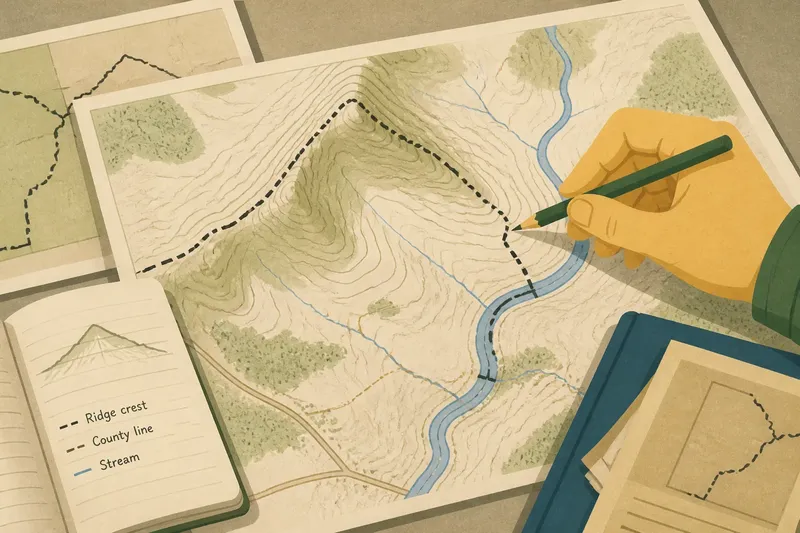
Start with the physical clue, then consider its location and scale. A name may refer to a small rise rather than a whole district, or to a feature that is no longer obvious. Compare the name with a topographic map, older maps where available and neighbouring names that may point to related terrain. A neat fit is not proof of origin; more than one explanation can fit the same landform.
If the feature does not match, do not force it. The mismatch may reflect landscape change, a different historical meaning or a mistaken interpretation. Record the question and leave the answer open until stronger evidence turns up.
Place-name forms vary between maps, signs and local speech
A place can have several forms in circulation: an official spelling, a local pronunciation, an older map form or a name used by one language community. These forms may serve different purposes rather than compete to be the single “real” name. A map editor may standardise spelling, while residents keep a spoken form that preserves sounds the map does not show.
When forms differ, note where each comes from and who uses it. Check the map’s date and purpose, compare signs and local sources, and listen for pronunciation rather than guessing from letters. In a region with more than one official or community language, retain the forms relevant to your account and explain their context instead of silently choosing one.
For general geographical writing, identifying the source and context of each form is more informative than flattening the variation into a single label.
What can a place-name clue tell you?
What can a place-name tell me on its own?
It can show the form used by a particular source and suggest questions about language, naming or landscape. It cannot, by itself, establish a complete origin, date, population history or boundary story.
Should I trust a familiar translation?
Use it as a possibility, then check whether older forms, local pronunciation and nearby names support it. A modern resemblance may be coincidental or may reflect later reshaping.
Why do maps show different names for the same place?
Maps may use different dates, spelling standards, languages or administrative conventions. Record the source and context of each form before deciding how to present it.
What should I do when a place-name’s origin is uncertain?
Say that it is uncertain and describe the evidence you can identify. Leaving a question open is more useful than turning a plausible suggestion into a settled claim.
Build a modest claim from several clues
Use a few concrete checks rather than searching for one grand translation. For each observation, let the result shape the next decision:
- Check the recorded form: Compare the spelling on a map with a sign or another map. If the forms agree, record that consistency; if they differ, note each source and date instead of silently choosing one.
- Check local speech: Look for a reliable pronunciation or locally used form. If one is documented, include it with its source; if not, avoid guessing pronunciation from the spelling.
- Check nearby names: Look for a possible element in neighbouring names. If it recurs in a plausible pattern, describe that pattern cautiously; if it does not, do not claim a local naming cluster.
- Check older forms: Compare historical maps or place-name records where available. If an older form supports your interpretation, cite it as supporting evidence; if it differs, preserve the variation and reconsider the reading.
- Check the landscape link: Identify the feature the name seems to describe and compare it with a topographic map or older map. If the location fits, call it a possible connection; if it does not, leave room for landscape change or another meaning.
- Check the strength of the claim: Separate recorded facts from interpretation in your notes. If independent sources support the explanation, state the support; if the name is the only clue, present the origin as uncertain.
Imagine you are writing a note about a village whose name seems to mean “hill settlement”. Your starting inputs are a current map spelling, an older map form that differs, two nearby names with a possible shared element and a topographic map showing the village below a low ridge. First, you record both spellings with their sources. Next, you compare the nearby names and note the possible pattern without treating it as proof. Then you check the apparent hill reference against the terrain; the ridge is nearby, but the village does not sit on it. Your resulting note can say that the name may preserve a local naming pattern, while its exact meaning and reference remain uncertain. The trade-off is clear: you offer a useful connection without claiming more than the clues support.
The place-name shortcut is tempting because one word can make a complicated landscape feel legible. Treat the name as an opening clue, compare it with its neighbours and setting, and say plainly where the evidence ends. That is the most useful way to explain a place-name: show both the connection it suggests and the limits of what it can tell.